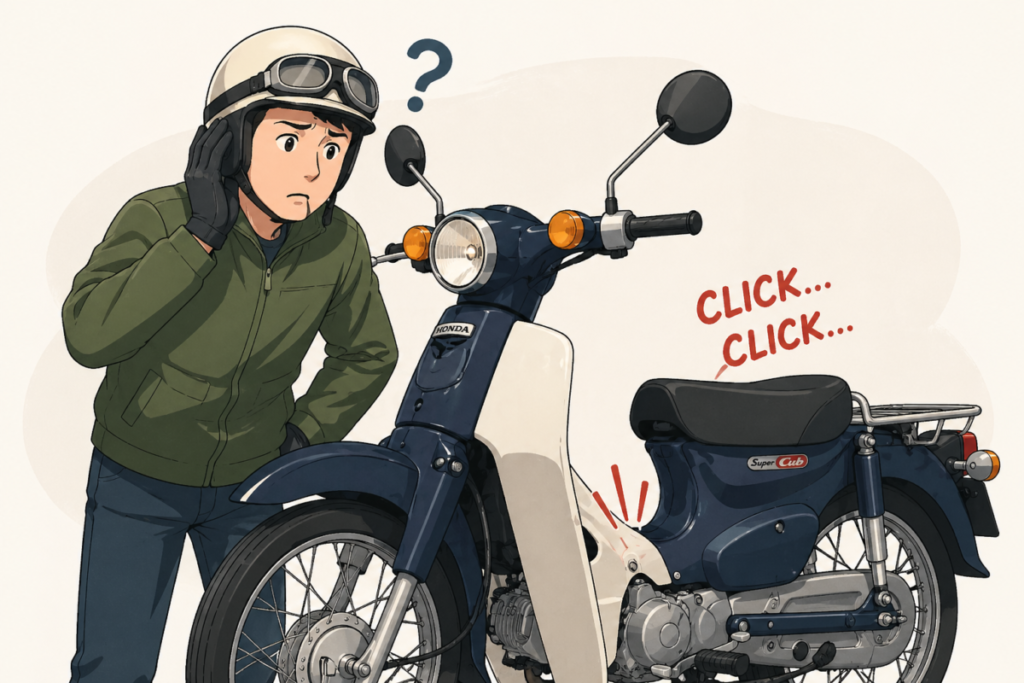
Hearing a clicking noise from your Honda Super Cub that won’t go away? Here are the 3 most common internal causes and what to do about each one.
A Super Cub clicking noise is often mistaken for a simple chain issue — but in many cases, the real cause is inside the engine.
If you’ve been riding your Honda Super Cub and noticed a faint metallic clicking at startup, or a chain-like rattle that persists even after you’ve adjusted your external chain — the problem might not be your chain at all.
The Super Cub’s engine relies on a set of internal timing components that most riders never think about until something goes wrong. The cam chain tensioner, oil pump gear, and chain guide roller all work together to keep the engine running in sync. When they wear down, the symptoms feel exactly like an external chain issue — but no amount of tension adjustment will fix what’s happening inside.
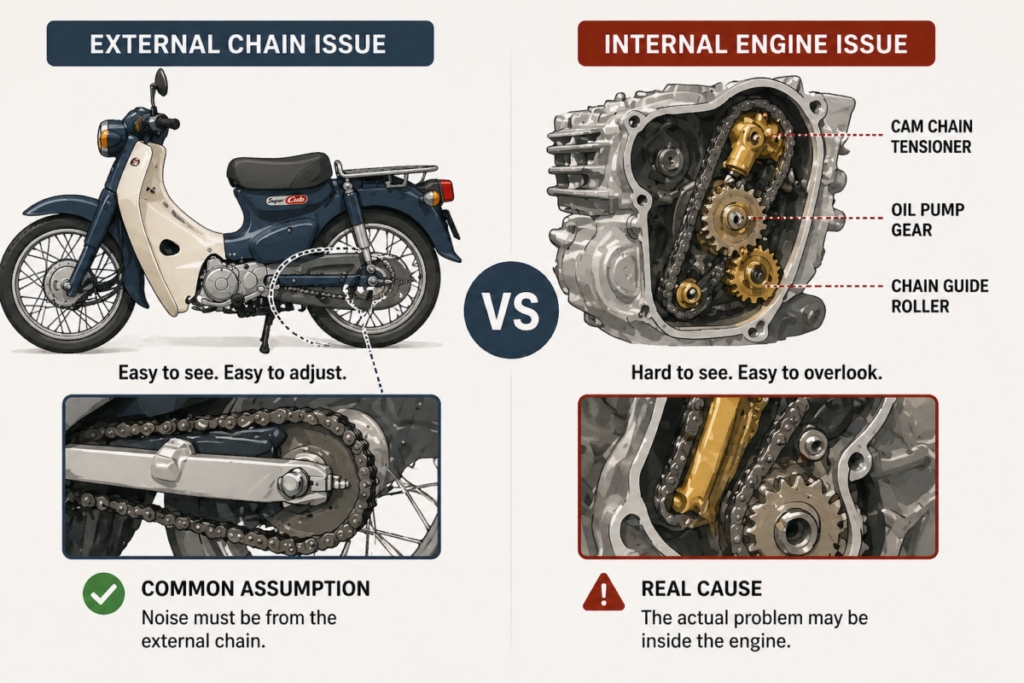
Why External Chain Adjustment Doesn’t Always Fix the Noise
The first thing most riders do when they hear clicking is check the chain. Tension gets adjusted, lubrication gets applied, and for a day or two the noise seems quieter. Then it comes back.
This pattern — temporary improvement followed by the same noise returning — is one of the clearest indicators that the source isn’t the external chain. The external chain connects the engine sprocket to the rear wheel. But inside the engine, there’s a separate timing chain system that drives the camshaft. These are two different systems, and adjusting one does nothing for the other.
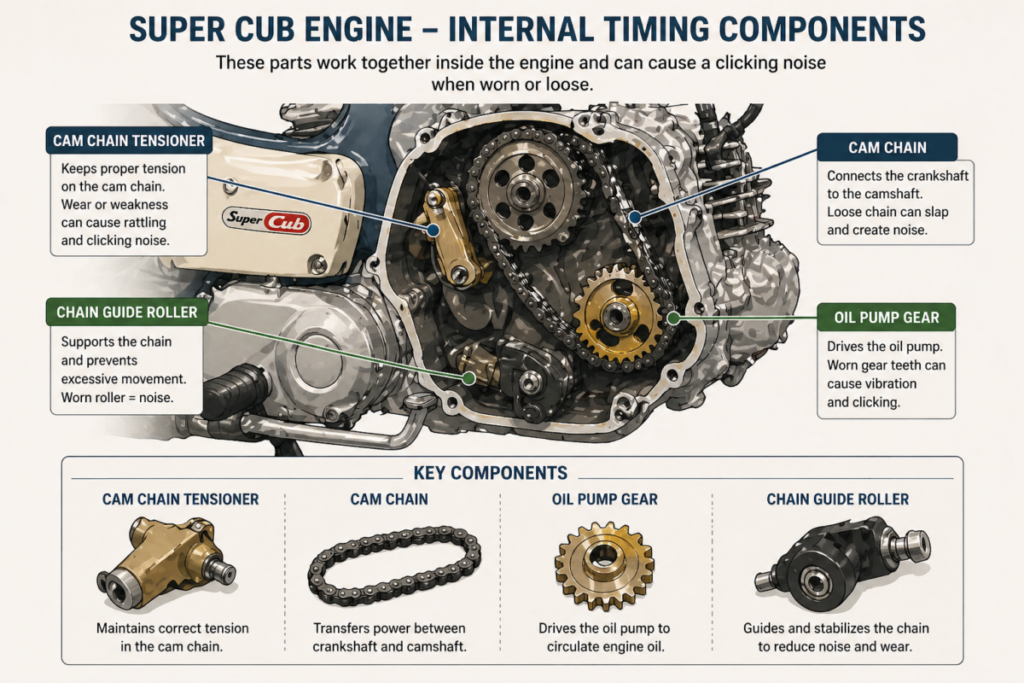
Cause 1: Worn Cam Chain Tensioner
The cam chain tensioner maintains consistent pressure on the timing chain inside the engine. Its job is to take up slack as the chain stretches with use, keeping it taut enough to run quietly and accurately.
As the tensioner wears, it gradually loses the ability to compensate for chain slack. The timing chain starts to slap against the engine casing on startup — which is that sharp metallic click that’s most noticeable when the engine is cold and fades slightly once oil pressure builds.
The characteristic pattern: louder on cold startup, quieter after warming up, but never fully silent. If this matches what you’re hearing, the tensioner is the most likely starting point.
Cause 2: Worn Oil Pump Gear
The oil pump gear drives the engine’s lubrication system. On the Super Cub, it’s part of the internal timing assembly and runs continuously whenever the engine is running.
As the gear teeth wear, two things happen. The gear itself starts generating noise — a grinding or rattling quality that sits underneath the main engine sound. More importantly, worn gear teeth affect the efficiency of oil delivery, which means other engine components are operating with slightly reduced lubrication over time.
The noise from a worn oil pump gear tends to be more consistent than tensioner noise — it doesn’t vary as clearly with engine temperature because it’s tied to engine speed rather than oil pressure buildup.
Cause 3: Worn Chain Guide Roller
The chain guide roller keeps the timing chain tracking in a straight line as it runs through the engine. Without it, the chain would flex laterally under load, creating contact with surrounding engine components.
A worn roller allows exactly this — the chain starts to wander slightly, making intermittent contact with the engine casing. The result is a hollow rattling sound that can seem to come from different locations depending on engine speed and load. Riders sometimes describe it as coming from “everywhere and nowhere” because the contact point changes as the chain moves.
This is often the last of the three components to become obviously noisy, but it tends to accelerate wear on the cam chain itself once it goes.
Signs These Components Need Attention
The following symptoms point toward internal timing wear rather than external chain issues.
A metallic clicking on startup that fades slightly once the engine warms up but never fully disappears. Chain adjustment that improves the noise temporarily but doesn’t resolve it. Subtle vibration through the engine that wasn’t present earlier in the bike’s life. Mileage above 20,000 to 30,000 kilometers without a documented internal timing service.
Any of these individually is worth investigating. More than one at the same time is a strong signal that the internal components are overdue for attention.
What the Fix Involves
Addressing internal timing wear on the Super Cub requires partial engine disassembly. The timing cover needs to come off to access the tensioner, oil pump gear, and chain guide roller. Once exposed, each component can be inspected individually and replaced as needed.
Because these three components work as a system and wear at similar rates, replacing them together rather than one at a time is generally the more practical approach. Replacing only the tensioner and leaving a worn guide roller, for example, means opening the engine again sooner than necessary.
For riders comfortable with engine work: this is a manageable job with basic mechanical tools and the Super Cub service manual. The engine design is straightforward, and timing alignment on the Super Cub is less complex than on many other bikes. A cam chain service on this platform is considered intermediate-level work.
For riders without engine experience: this is the type of job to hand to a shop. The labor cost is typically reasonable given the engine’s simplicity, and having the work done correctly the first time avoids the risk of timing misalignment — which creates problems significantly worse than the original noise
Frequently Asked Questions
Q. How do I know if the clicking is internal or external?
Adjust your external chain to the correct tension and lubricate it. If the noise persists at the same level or only improves slightly, the source is likely internal. External chain noise responds clearly to adjustment and lubrication. Internal timing noise does not.
Q. Can I keep riding with this noise?
For a short period, yes. The noise itself doesn’t mean the engine is about to fail. But internal timing wear does progress, and a worn oil pump gear affects lubrication efficiency over time. Addressing it sooner rather than later is the practical choice.
Q. How long does the repair take?
For an experienced mechanic familiar with the Super Cub, a cam chain service typically takes two to four hours. For someone doing it for the first time, allow more time and work carefully with the service manual.
Q. Does this affect all Super Cub models?
The internal timing system is present across Super Cub variants, though specific components vary by engine generation. The symptoms described here apply broadly, but the exact parts needed depend on your specific model and year.
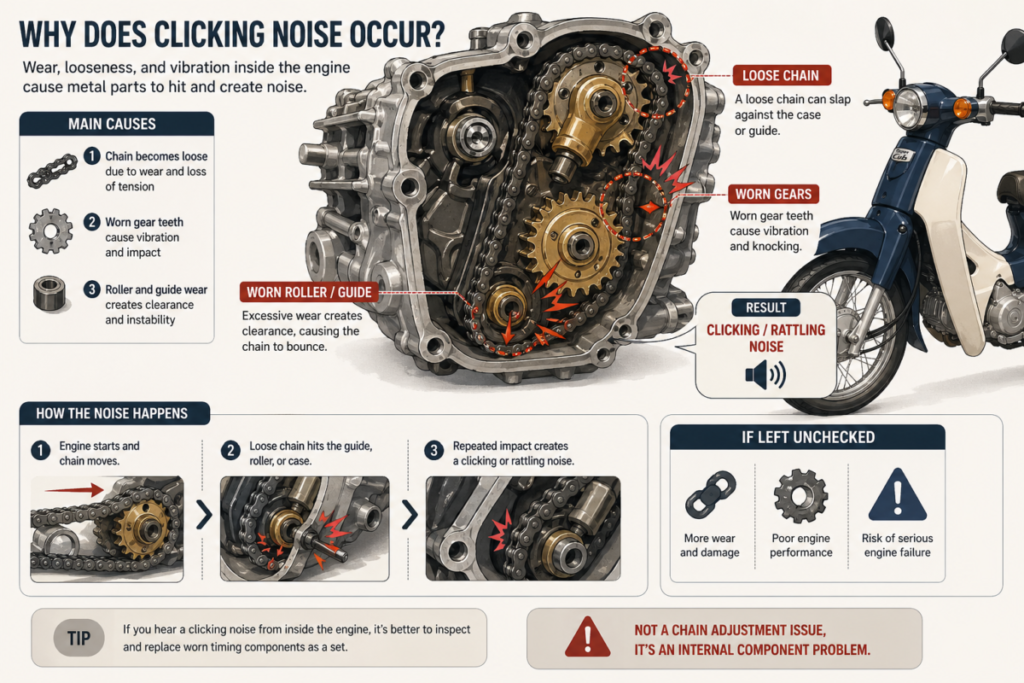
The Bottom Line
A clicking noise that persists after external chain adjustment isn’t something to wait out. The three most likely internal causes — cam chain tensioner, oil pump gear, and chain guide roller — all wear gradually and all produce similar symptoms in their early stages.
Identifying which component is responsible early makes the repair straightforward. Waiting until the noise becomes severe increases the risk of secondary damage and makes the job more involved.
If the pattern matches what you’re hearing, the next step is getting inside the engine to see what’s actually going on.